Artificial intelligence is no longer something only engineers and researchers talk about. It now writes emails, summarizes long documents, designs graphics, answers customer questions and helps businesses make decisions faster. If you have been wondering whether it is worth your time to learn AI, the short answer is yes. Here are seven reasons why learning AI is one of the smartest moves you can make this year, followed by a simple plan for getting started.
1. AI skills make you more employable
Employers in almost every industry now want people who can work alongside AI tools. Whether you work in marketing, finance, education, healthcare or customer service, knowing how to use AI well sets you apart from candidates who do not. You are not competing with the technology. You are showing that you can use it to produce better work in less time, and that is exactly what hiring managers look for when they review applications and promote people.
2. You will save hours every week
Much of the working day goes to repetitive tasks: drafting emails, writing reports, tidying spreadsheets, taking meeting notes and researching a topic from scratch. AI tools can produce a first draft of most of these in seconds. You still review and improve the result, but the heavy lifting is done. Over a week, those saved minutes add up to hours you can spend on strategy, creative work or simply finishing earlier. People who learn AI properly also learn which tasks to hand over and which to keep for themselves.
3. AI opens new ways to earn income
AI has made it easier to start earning online. Freelancers use it to produce content, edit videos, translate documents, manage social media accounts and research topics for clients faster than before. Entrepreneurs use it to create digital products, write sales pages and answer customer questions around the clock. When you know how to guide AI tools well, you can take on more clients, deliver faster and build an income stream that does not depend on a single employer.
4. It gives small businesses a real edge
Large companies once held an advantage because they could afford big teams for design, writing, analytics and support. AI narrows that gap. A small business owner can now draft marketing copy, analyze customer feedback, plan a content calendar and automate routine replies without hiring a full department. Learning AI helps you compete with larger players using the resources you already have, which matters a great deal when budgets are tight and every hour counts.
5. You will think and learn faster
AI is also a patient tutor. You can ask it to explain a difficult concept in simple language, quiz you on what you studied, summarize a long article or help you practice a new language. Because it responds instantly, you can learn at your own pace and ask as many follow-up questions as you like. Used well, it speeds up learning in any field, which means that learning AI makes it easier to learn almost everything else.
6. AI literacy protects you from being left behind
AI is becoming part of everyday tools, from search engines and phones to workplace software. Understanding how it works helps you use it wisely and spot its weaknesses. AI can make confident mistakes, reflect bias from its training data and create privacy risks when you share sensitive information. People who understand these limits know when to double-check an answer and what never to paste into a chatbot. That kind of AI literacy is quickly becoming as basic as knowing how to use the internet.
7. You do not need to be a coder
Many people assume AI is only for programmers. It is not. Most of today’s AI tools work through plain language: you type what you need, and the tool responds. Learning to write clear instructions, known as prompting, matters far more than knowing how to code. If you enjoy technical work, there is plenty of room to go deeper into data, automation and machine learning later. But the entry point is open to anyone who can read, write and think clearly.
Will AI take my job?
This is the question most people ask, and it deserves an honest answer. AI will change many jobs, and some tasks will be automated. But in most roles the biggest shift is that the work itself changes, and people who can use AI tools adapt more easily than those who cannot. Rather than fearing the technology, treat it as a skill to build. The sooner you understand what AI does well and where it falls short, the better placed you will be to grow your career instead of reacting to change.
How to start learning AI today
You do not need months of preparation to begin. Follow these steps:
- Pick one tool and use it daily. Choose a popular AI assistant and use it for real tasks, such as drafting an email or planning your week.
- Learn how to write good prompts. Be specific about your goal, your audience and the format you want. Better instructions produce better results.
- Always check the output. Verify facts, names and numbers before you share or publish anything.
- Apply AI to your own field. A teacher, a trader and a designer will each find different uses, so look for the ones that fit your work.
- Take a structured course. Guided lessons help you avoid gaps and build skills faster than trial and error alone.
- Build something small. A simple project, such as a content plan or an automated workflow, turns what you know into proof of skill.
Final thoughts
AI is changing how people work, earn and learn, and the gap between those who understand it and those who do not keeps growing. The good news is that it is still early, and you can start from zero. If you want a clear path to follow, explore the AI to Profit Course on Kdemia and begin turning AI skills into real results. The best time to learn AI was yesterday. The next best time is today.
You May Also Like

-
Nov 2, 2026
Why does your business need content? Discover 6 ways content marketing builds trust, brings in customers and lowers costs, plus...
-
Oct 30, 2026
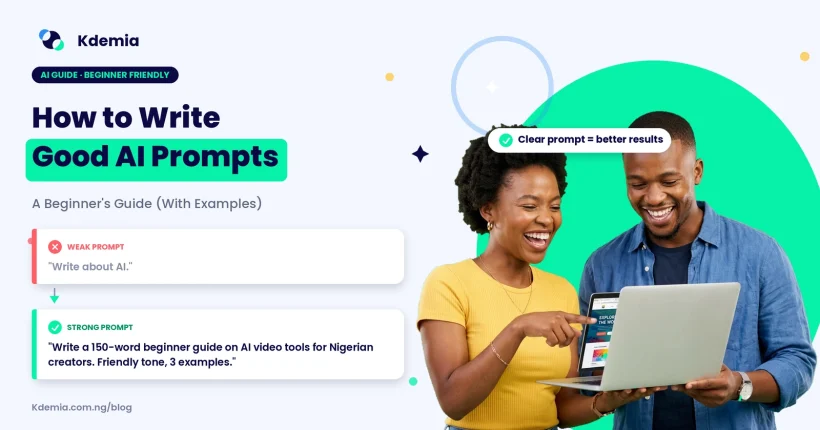
Getting weak answers from AI? Learn how to write good AI prompts with a simple five-part formula, before-and-after examples and...
Sign up to receive our latest updates
Join Us
- © 2026 Kdemia. All rights reserved.